Certification & Grading
A gemstone without a credible laboratory report is a gemstone without provable identity, treatment status, or origin. In the coloured stone market — where visual appearance alone cannot reveal whether a sapphire has been heated, diffused, or even synthesised — independent certification is not a luxury. It is the mechanism that makes informed buying possible. This hub covers the major laboratories, what their reports contain, and how to use that information.
Written by
Serendib Gemstones Editorial
Written by our in-house team of Sri Lankan gemstone specialists — sourcing, cutting, and certification professionals working out of Kochchikade, Sri Lanka.
Reviewed by: Thusira Ranasinghe — Co-Founder & Director, Serendib Gemstones (Pvt) Ltd
Last updated
12 August 2026
Context
Why certification matters
Unlike diamonds, which are graded on a standardised scale of cut, colour, clarity, and carat weight, coloured gemstones resist easy standardisation. Two sapphires that appear identical under normal lighting can differ radically in treatment status, origin, and therefore value. The same Sri Lankan blue sapphire, confirmed unheated with fine natural colour, can command a very significant premium over its heated counterpart — but only a laboratory can make that determination reliably.
Certification also provides the documentary foundation for resale, insurance, and estate planning. A stone purchased today with a current GIA or GRS report carries that provenance forward indefinitely. A stone without documentation is, at the point of resale, simply an unverified coloured gem — and the market discounts accordingly.
We certify every stone in our collection through either GIA or GRS, and we encourage buyers to understand what those reports contain. Our verification process explains how we use laboratory reports as part of our sourcing workflow.
Related reading: GIA vs GRS · How origin is determined · What “no heat” means · Ceylon Gem Identity
Worked Example
A GRS report, in the flesh
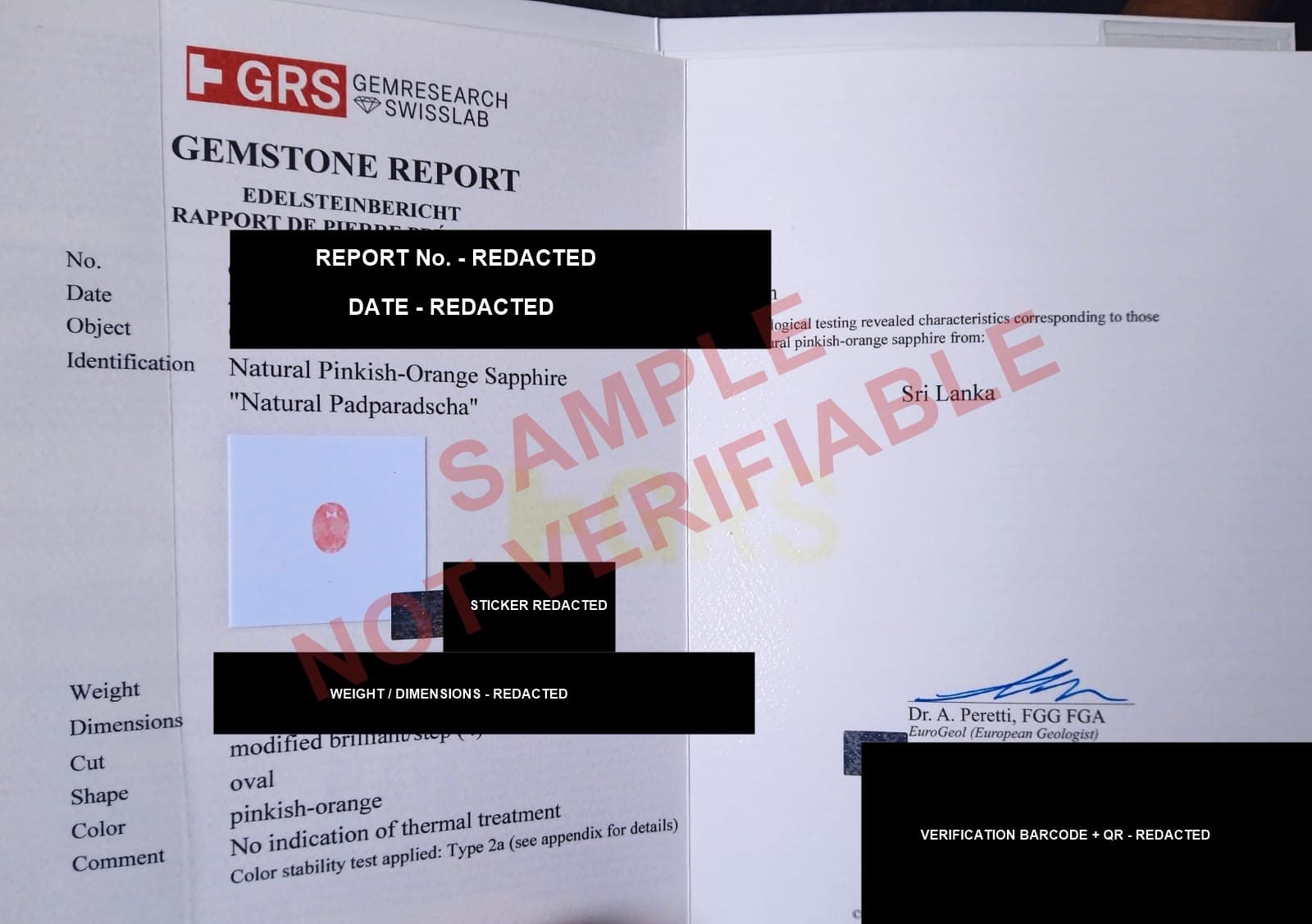
Rather than describe a laboratory report abstractly, here is one we hold — a genuine GRS Gemresearch Swisslab report for a natural Ceylon padparadscha. The stone has been sold; identifying fields are blacked out so nothing traces back to the current owner. The right-hand column labels every visible field so you can read a GRS report yourself.
Actual report
A real GRS certificate
A photograph of a genuine GRS Gemresearch Swisslab report opened flat — one Serendib holds for a padparadscha we sold. Report number, issue date, weight, dimensions, the on-stone ID sticker, and the verification barcode / QR pair have all been blacked out to protect the current owner. What remains is the classification, origin, cut, colour, and treatment disclosure that make the report meaningful.
What each field means
Reading the report, line by line
The same report as a labelled layout. Public fields are the parts a buyer relies on — origin, identification, treatment. Private fields are what tie a report to a specific stone; those are the ones we redact.
No.
[Redacted — unique report ID]
Every GRS report carries a unique reference number that can be looked up on gemresearch.ch. Hidden here so this example cannot be tied back to a specific stone sale.
Date
[Redacted]
Issue date — hidden for the same reason as the report number.
Object
One faceted gemstone
Identification
Natural Pinkish-Orange Sapphire · "Natural Padparadscha"
The formal species / variety determination — the answer to "is this really a padparadscha?"
Origin
Sri Lanka
Trace-element chemistry and inclusions matched to the Ceylon geological signature.
Weight
[Redacted]
Carat weight is a fingerprint. Combined with dimensions it uniquely identifies a stone, so we hide both.
Dimensions
[Redacted]
Cut
Modified brilliant / step (4)
Shape
Oval
Color
Pinkish-orange
The specific hue that defines a padparadscha.
Comment
No indication of thermal treatment
The most valuable field on the whole report. This single line adds the "unheated" premium.
Color stability test applied: Type 2a
GRS-specific stability confirmation for pink / orange sapphires.
Verification
[Barcode + QR redacted]
A GRS report carries a barcode and QR that verify authenticity against gemresearch.ch. Redacted here so the stone cannot be traced.
Illustrative example only. The real GRS Verification Portal at gemresearch.ch is the authoritative source for any active report.
Reference
Major laboratories
Four laboratories dominate the coloured gemstone certification landscape. Each has a distinct methodology, market focus, and reputation — and understanding their differences helps you evaluate the report that accompanies any stone.
GIA
Gemological Institute of AmericaCarlsbad, USA (with global offices)
The world's most recognised gemological laboratory and the standard-setter for diamond grading. For coloured stones, GIA reports are valued for their conservative, highly credible approach. Their treatment determinations — particularly "No indications of heating" — are accepted without question by every major auction house and dealer. GIA does not assign commercial colour grades (such as "Royal Blue" or "Pigeon Blood"), preferring objective descriptions.
Key strength: Universally accepted, conservative methodology, strongest brand recognition in the US and European markets.
GRS
GemResearch SwisslabLucerne, Switzerland (with offices in Hong Kong, Bangkok)
Founded by Dr Adolf Peretti, GRS is the leading laboratory for coloured gemstone identification and origin determination. GRS pioneered the use of trace-element analysis for origin determination and is widely respected for its depth of expertise in sapphires, rubies, and emeralds. Unlike GIA, GRS assigns commercial colour grades — "Royal Blue", "Cornflower Blue", "Pigeon Blood" — that carry significant market weight, particularly in Asian markets.
Key strength: Deep coloured stone expertise, commercial colour grades with market impact, strong recognition in Asian and auction markets.
Gubelin
Gubelin Gem LabLucerne, Switzerland
The oldest continuously operating gemological laboratory, founded in 1923. Gubelin built its reputation on inclusion research — much of what the trade knows about the internal features of coloured stones originates from their scientific work. Their reports are considered the gold standard for provenance and are particularly valued by established European dealers, collectors, and auction houses. Gubelin also pioneered the Provenance Proof initiative for supply chain transparency.
Key strength: Historic authority, unmatched inclusion expertise, strong European and auction market credibility.
SSEF
Swiss Gemmological InstituteBasel, Switzerland
Affiliated with the Swiss Foundation for the Research of Gemstones, SSEF is a research-driven laboratory known for its scientific rigour. SSEF reports are regularly cited in academic gemological literature and are trusted by the most discerning private collectors and institutional buyers. Their advanced analytical techniques — including LA-ICP-MS trace element mapping — are among the most sophisticated in the industry.
Key strength: Academic rigour, advanced analytical methods, trusted by institutional buyers and high-end auction houses.
Quick Reference
What a certificate tells you
Every coloured stone report from a reputable laboratory addresses the same five core questions. Here is what each field means and why it matters.
Identification
Confirms the stone is natural corundum (sapphire or ruby) and not a synthetic, simulant, or other species entirely. This is the most fundamental determination — everything else on the report depends on it.
Treatment Status
States whether the laboratory found evidence of heat treatment, beryllium diffusion, flux healing, or other enhancements. For sapphires, the critical phrase is "No indications of heating" (GIA) or "No heat" (GRS). This single determination has the largest impact on value.
Geographic Origin
Assigns a geographic origin based on trace element chemistry and inclusion analysis — for example, "Sri Lanka (Ceylon)", "Kashmir", or "Madagascar". Origin carries significant value implications: a confirmed Ceylon origin adds a measurable premium over stones from less prestigious sources.
Colour Description
Describes or grades the stone's colour. GIA uses descriptive terms; GRS assigns commercial grades like "Royal Blue" or "Vivid" that carry market weight. Colour is the primary aesthetic factor in sapphire valuation.
Measurements & Weight
Records the stone's dimensions in millimetres and its carat weight to two decimal places. These measurements allow precise identification and ensure the report matches the physical stone presented for sale.
Guides
Certification guides
Coming Soon
More certification guides on the way
How to read a GIA coloured stone report — field by field
GRS colour grades explained — Royal Blue, Cornflower, Vivid, and more
When to get a second laboratory opinion on your gemstone
Certificate fraud — how to verify a laboratory report is genuine
Sources & References
This article draws on published gemological literature, laboratory reports, and industry standards. Consult the primary sources below for verification.
- GIA — Gemological Institute of America — Coloured stone identification, treatment disclosure, and origin reports
- GRS — GemResearch Swisslab — Colour grading (Royal Blue, Cornflower, Pigeon Blood) and origin determination
- SSEF — Swiss Gemmological Institute — Advanced spectroscopy and origin determination
- Gübelin Gem Lab — Origin determination, inclusion research, and Provenance Proof initiative
- AGL — American Gemological Laboratories — Coloured stone reports and treatment disclosure
- CIBJO — The World Jewellery Confederation — International gemstone nomenclature and disclosure standards (Blue Books)
- Gems & Gemology (GIA quarterly journal) — Peer-reviewed research on gemstone identification and treatment detection
Information in this article reflects industry practice and gemological consensus at the time of publication. Gemstone valuation, availability, and market conditions vary continuously — for current information about a specific stone, please make an enquiry.
Serendib Gemstones
Every stone certified, every report current
We certify every stone through GIA or GRS before it enters our collection. Each listing includes a verifiable report number so you can confirm the details independently.