Gemstone Library
Bi-Colour Sapphire
Quick Answer
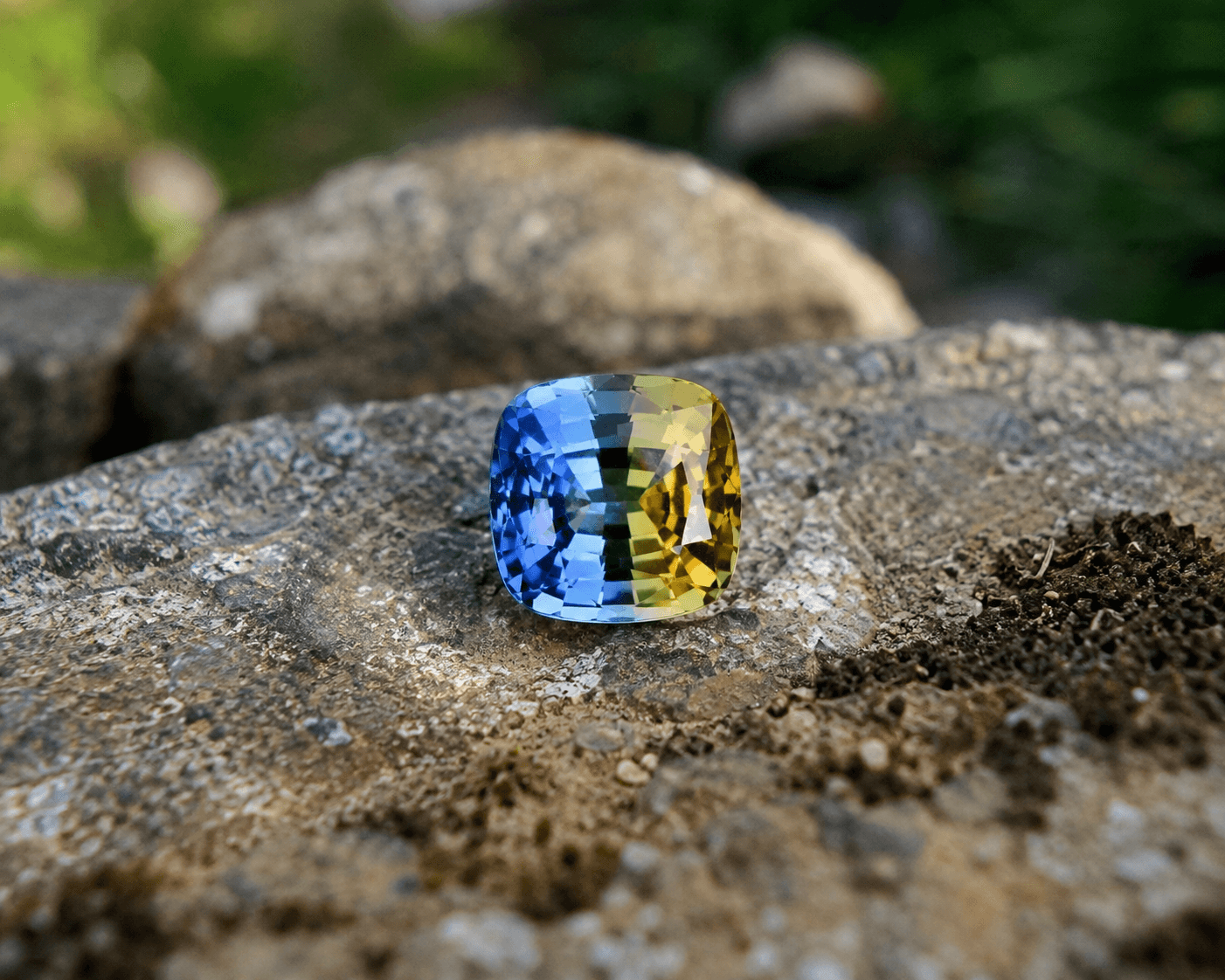
A bi-colour sapphire is a single natural corundum crystal that shows two distinct colours in one stone — most often blue and yellow, or pink and orange — the result of colour zoning that happened as the crystal grew. Sri Lanka (Ceylon) is a leading source. Because heat treatment tends to blur the boundary between the two zones, well-preserved bi-colours are almost always natural, untreated, and cut so that both colours read clearly from the face-up view.
Corundum
Mineral
9 / 10
Hardness
Sri Lanka
Top Origin
Usually None
Treatment
What Is a Bi-Colour Sapphire?
A bi-colour sapphire is one continuous corundum crystal that carries two distinct colours in different zones of the same stone. The colours are the crystal's own — nothing is layered, coated, or joined. In the trade, bi-colour sapphires are also called parti-coloured sapphires or, when the zoning is visible enough to define the stone, simply colour-zoned sapphires. What separates a bi-colour from a stone with mild zoning is the sharpness of the boundary and the vividness of both colours face-up.
How Bi-Colour Sapphires Form
Corundum takes its colour from trace elements: iron and titanium together give blue; iron alone gives yellow; chromium gives pink or red. Bi-colour zoning happens when the chemistry of the mineralising fluid changes during growth. The trace elements that were feeding the crystal shift — a burst of titanium creates a blue band; a stretch without it and with more iron creates yellow; a moment of chromium creates pink. Because the crystal keeps growing throughout, the result is one seamless stone with abrupt colour transitions rather than a joined composite.
Ceylon Bi-Colour Sapphires
Sri Lanka's Ratnapura and Elahera fields produce a large share of the world's marketable bi-colour sapphires. Ceylon bi-colours are prized for three reasons: the individual zones are usually bright and clean rather than muddy; the boundaries between colours tend to be sharp; and blue-yellow combinations — the most commercially recognised — occur here more often than in almost any other origin. Fine Ceylon bi-colours have been recorded historically at all the major auction houses, though the market for them is smaller and more specialist than the market for single-colour sapphires.
Cutting a Bi-Colour Sapphire
Cutting is where a bi-colour sapphire becomes either a design piece or a curiosity. The cutter first studies the rough to map where the colours sit. Then they make a design decision:
- Split the stone. Orient the rough so the boundary runs straight across the face-up view — the stone reads as two equal halves. Emerald and cushion cuts suit this best.
- Anchor one colour. Make one colour the dominant field and let the second show as a stripe, corner, or crescent. Rings often use this treatment.
- Read both from the face. Orient the rough so both colours are visible from directly above, even if the boundary is diagonal. Requires a shallower cut and more waste.
A well-cut bi-colour presents both colours cleanly from the face. A poorly cut one either loses one of the colours to the pavilion or lets the boundary appear only from the side. Because the rough is naturally rare, cutting waste on bi-colours is high — expect a lower yield than a same-weight single-colour rough.
Treatments & Certification
Bi-colour sapphires are almost always sold unheated. Heat treatment is the standard enhancement for single-colour sapphires, but on a bi-colour it tends to blur the boundary between the two zones or wash one of them out. A well-preserved bi-colour with sharp zoning is therefore, in most cases, a natural stone that has not seen the furnace — but the only way to be certain is an independent laboratory report.
Any bi-colour sapphire sold as unheated should carry a report from GIA, GRS, Gübelin, or SSEF confirming “no indications of heating”. For high-value stones a mention of the specific colour zones and their sharpness in the report's comments section adds substantial resale value. See our worked example of a redacted GRS report for a walk-through of what each field means.
Buying Considerations
- Colour vividness. Both zones should be saturated and read as themselves. A pale yellow next to a pale blue reads as a grey stone; a vivid yellow next to a vivid blue reads as a bi-colour.
- Boundary sharpness. The transition from one colour to the other should be a clean line, not a slow fade. Sharp boundaries are the mark of natural, untreated bi-colours.
- Face-up presentation. Both colours should be visible from directly above. If one only appears from the side, cutting has failed the stone.
- Zone proportions. Even splits are the most recognised in the market, but stones with a dominant colour and a smaller accent zone can be more design-forward and often cost less per carat.
- Origin. Ceylon bi-colours tend to have brighter individual zones and cleaner boundaries than most other origins.
- Certification. Insist on an unheated determination from a leading laboratory. It is the single most important factor in resale value.
Frequently Asked
Bi-Colour Sapphire FAQ
What is a bi-colour sapphire?+
A bi-colour sapphire is a single natural corundum crystal that displays two visibly different colours within the same stone — most commonly blue and yellow, but also blue and green, pink and orange, or yellow and green. The colours are separated in distinct zones, not blended together, and both are the stone's natural colour — no treatment creates a bi-colour effect. Bi-colour sapphires are also called "parti-coloured" or "colour-zoned" sapphires in the trade.
How does a bi-colour sapphire form?+
Bi-colour sapphires form when the chemistry of the fluid feeding a corundum crystal changes during growth. The trace elements that give sapphire its colour — iron and titanium for blue, iron alone for yellow, chromium for pink — enter the crystal at different rates as conditions shift, producing bands or sectors of different colours within a single continuous stone. Because both colours belong to the same crystal, they share the same optical properties, hardness, and durability.
Which colour combinations occur in bi-colour sapphires?+
The most common combinations are (1) blue and yellow — the classic Ceylon bi-colour, often with a sharp boundary between the two zones; (2) blue and green — a subtle transition through the teal range; (3) pink and orange — the rarest and most valuable, sometimes graded as bi-colour padparadscha; (4) yellow and green; and (5) blue, yellow and clear together (tri-colour). Vivid, well-separated zones with clear boundaries are most valued.
Why is Sri Lanka a leading source?+
Sri Lanka's Ratnapura and Elahera fields produce a large share of the world's bi-colour sapphires because the geological conditions there favour the chemical shifts that create colour zoning. Ceylon bi-colours are prized for the brightness of both zones, the clarity of the boundary between them, and the relatively high proportion of blue-yellow combinations, which are the most commercially recognised.
How should a bi-colour sapphire be cut?+
Cutting a bi-colour sapphire is a design decision, not just a technical one. The cutter chooses whether to (1) split the colours evenly across the stone, making the boundary the focal point; (2) emphasise one colour and let the second show as an accent; or (3) orient the rough so both colours read from the face-up view. A well-cut bi-colour reads as two clear colours from the top; a poorly cut one appears muddy or shows the zoning only from the side. Emerald cuts and cushions suit bi-colours particularly well because they showcase the boundary cleanly.
Are bi-colour sapphires treated?+
Bi-colour sapphires are usually sold unheated because heat treatment can blur the boundary between the two colour zones or even eliminate one of them entirely. A well-preserved bi-colour with sharp zoning is almost always natural and untreated. Any bi-colour sapphire sold as unheated should carry an independent laboratory report from GIA, GRS, Gübelin, or SSEF confirming no thermal treatment.
How rare are bi-colour sapphires?+
Bi-colour sapphires are considerably rarer than single-colour sapphires — most rough corundum forms with a single colour or with zoning too subtle to be noticed. Only a small fraction of mined rough has clearly defined, marketable bi-colour zoning, and an even smaller fraction survives cutting with the zones intact. Well-cut, vivid bi-colours above 3 carats are collector-grade stones.
Related Gemstones